Thursday, September 14, 2023

The Power of Light

As the northern hemisphere heads towards the fall equinox, and as Victoria moves towards winter's greyer skies, I've been thinking about light, and all the various ways that light moves and shapes us. In this post I'm looking at light, from a few "random" perspectiives. 

When the Light is Right

Photographers depend on the right light, and I've known those that have waited for hours for the light to be "just right". I am more a photographer of opportunity, so the images in this post are those that I happened upon in a magical moment when the light was favorable.

And sometimes, light does create a magical moment or two. Here are a few images...
Light in the southeast over the Strait of Juan de Fuca as the sun sets early on a winter afternoon

Sunrise over Juan de Fuca Strait

January sunset from our apartment, with the sun setting far to the south!
Although cruise ships are not for me, and the cruise ship industry is blamed for a host of environmental ills, they do have a way of creating an illusory world, as the photo below shows.

Cruise ship at Ogden Point

Mood and Light

Light cheers us up; how often have we noticed this in our own spaces, that there is a buoyancy to a room with light? I noticed this recently, after a day when I was feeling down about a host of planetary challenges. I went for an evening walk, and was greeted with the scene in the photo below.

The setting sun created these long shadows with their interesting patterns, with the partial rainbow in the distance. After a day of feeling gloomy, I felt the message of the rainbow.

It's not often that I post images of high rises, but with the theme of light and mood, the next two images speaks to me of airiness.

This downtown Victoria office building seems to be all about sky and light. 

Upper Harbour Place in Vic West. The elegant turquoise hues of the glass capture light and sky.


Illuminating the Details

Artists need light to produce their work, and we need the light to appreciate their efforts, and the detail that went into producing it.. 


Late afternoon light illuminates stonework details of the BC Legislature. I enjoyed the way the bare branches of the tree were reflected in the building's window glass.

Light can reveal details -- details that we might otherwise miss.
The long rays of the sun illuminated several details of this building's features -- the bay windows on each floor, the metal rails of the balconies, and the rhythmic pattern of the fire escape ladders. 

These doors on the Legislature are normally unobtrusive, but the setting sun illuminated them indirectly, as well as the attractive terra cotta colours of the tile.

Light helps this business stand out, with its extensive glass exterior, and the attractive tone of blue complementing the well chosen orange tables and chairs.

Light transforms the ordinary into memorable.

Light catching the flowers of a spurge plant, and showing the detail of each flower. Some spurges are invasive; I believe this one is Myrtle Spurge which seems to be very hardy, possibly to the point of an invasive plant. I've seen it growing out of the sidewalk, in the tiny crack between a power pole and the sidewalk concrete. 

The light illuminating the figure's face, and the colourful hanging paper balloons, helps make this image interesting.

Nature and Light

We depend on the sun, and light, for our survival, and the survival of all flora and fauna.

A natural area in the interior of BC

A xeriscaped Victoria garden along south-facing Dallas Road
Arbutus tree, Victoria


When water and light are abundant, nature thrives.

A snippet of rich and verdant growth in Beacon Hill Park

Light illuminates the seedheads of these landscape onion plants


Photography and Light

And light is essential for the photographer, who depends on it to "highlight" and shape what we photograph. This point becomes vivid when a photograph is viewed in black and white and shades of grey. 

Here is the arbutus tree shown earlier in colour, now in black and white.

Black and white version of the arbutus tree shown earlier. 
Sometimes because colour can by so "eye-popping", we don't know about light levels and contrast within a photograph until it's been converted to black and white.

Here is one more earlier photo, converted to black and white:

Colour photography allows the photographer to be less demanding of light in the image. The colours of the balloon fade into the background when the image is seen in its black and white version.

Light illuminating fungi growing on a dead log.

Black and white version of the above photo, showing the levels of contrast in light.


Playing with Light

Residents of northern countries with long winters know what it's like to miss the light. Since I've lived in James Bay there's been a "Window Wanderland" project each winter, celebrating the light that we create within our own homes, and shining images onto the streets for our neighbours.

This is a window from the February James Bay "Window Wanderland". Residents were invited to decorate their windows, which they then illuminated from behind with the light of a room. Maps of all who had registered were available from the Community School, and over two nights, residents could "wander" the streets, enjoy the dark night, and the warmth of lit up windows.
Another Window Wanderland window.
And one more window from Window Wanderland.

Exploring and playing with all the aspects of light has reminded me of the Robert Louis Stevenson poem "My Shadow", which I enjoyed both as a child, and as a parent.


My Shadow by Robert Louis Stevenson

I have a little shadow that goes in and out with me,
And what can be the use of him is more than I can see.
He is very, very like me from the heels up to the head;
And I see him jump before me, when I jump into my bed.

The funniest thing about him is the way he likes to grow—
Not at all like proper children, which is always very slow;
For he sometimes shoots up taller like an india-rubber ball,
And he sometimes gets so little that there's none of him at all.

He hasn't got a notion of how children ought to play,
And can only make a fool of me in every sort of way.
He stays so close beside me, he's a coward you can see;
I'd think shame to stick to nursie as that shadow sticks to me!

One morning, very early, before the sun was up,
I rose and found the shining dew on every buttercup;
But my lazy little shadow, like an arrant sleepy-head,
Had stayed at home behind me and was fast asleep in bed.

Your blogger's shadow

Using Light for Energy

I will finish my brief tour of light with a stop at the role of the sun's light for energy: solar power.

It's hard to capture images of many solar installations, since they are mostly above the view of my lens. For example, the Capital Park development, which I've featured in this blog before, has 251 solar panels on the rooftops of two office buildings, but most of them are barely visible.

But here's one solar installation I was able to capture:

House on Moss Street in Fairfield

New buildings in Victoria often have solar arrays on their roofs; let's have more at the level of the individual home! One website I consulted suggests Victoria has 2,200 hours of sun on average in a year.

Average monthly sunhours in Victoria. Source: https://weather-and-climate.com/average-monthly-hours-Sunshine,victoria,Canada


Opening and Closing the Day

Greeting the light in the morning, and saying farewell at night: two of the most common images in photographs. Here is a recent shot from a morning walk.

Sunrise, Juan de Fuca Strait

 And I will finish this tribute to light with a photo of the setting sun from a few months ago.

A zoom in on the setting sun, with a halo of light.

Wednesday, August 23, 2023

In Praise of Diversity - Part 1

One of the things I value and enjoy about James Bay is its diversity, and the stimulating environment which results. The community is a rich potpourri of sights, sounds, smells and taste -- even touch, every time I visit an ocean beach. 

There are always people walking on the street in James Bay, and I think one of the reasons is its diversity. Its walkability means that it's a great example of sustainability.

Demographically, there are people in all stages of their lives -- many seniors, but also enough children for two elementary schools. And there are people of all incomes, from those wealthy enough to own and maintain a home in the community, to those with few possessions and who live on the streets, in their vehicles, or rough on the beaches. Nothing about James Bay feels sterile or sanitized. Being part of this diversity connects me to my human-ness.

James Bay is definitely not like the monotonous housing-only suburbs that were popular when I cut my teeth as a city planner in the 1970s. It has a range of housing types, from high rise apartments to single family houses. But it also has a mix of other land uses -- including industry, a great variety of small retail and service businesses, a library, churches and parks, as well as services catering to tourists such as hotels. 

Industry

I'll start this brief overview of diversity with James Bay's industrial roots. Industry bumps up against commercial and residential, all in a small area at the northwest tip of James Bay -- Fisherman's Wharf. 

As its name implies, Fisherman's Wharf was built to accommodate fishing vessels -- up to 60 large fish-packing vessels -- when it was opened after World War II. At the time, Victoria's waterfront was largely industrial.
Fisherman's Wharf combines industrial, commercial, and residential use in one corner of James Bay. In this photo you can see both tourist commercial operations, and floating homes. And, given its historical roots, Fisherman's Wharf is still a place of fishing industry activity.
The next photo gives an example of industry and residential development side by side on a quiet street, just a block from Fisherman's Wharf. Many planners might say this isn't a desirable way to build a community, but it seems to work in James Bay.
A posh residential development in the background, with a seafood processor and distributor in the foreground.
While the scale of Fisherman's Wharf might have been dramatic in the heyday of fishing, Ogden Point, south of Fisherman's Wharf, is the most significant part of Victoria's industrial waterfront. 

From 1883 to 1914 the area to the north (where DFO and the Coast Guard now have extensive facilities) was known as Rithet's Piers, and established Victoria as Canada's largest seaport on the Pacific. After World War I, and with the opening of the Panama Canal, a new breakwater and wharf facility was built at Ogden Point. The breakwater was necessary to protect the wharves from winter storms. Constructing the Ogden Point facility was BC's first "mega project", according to the Victoria Harbour History website.

Ogden Point Wharves after the construction of the breakwater in 1916. Source: https://www.victoriaharbourhistory.com/locations/outer-harbour/ogden-point/

The breakwater is one of those engineering projects which has stood the test of time, withstanding nature's forces for over a hundred years. I wonder how it will fare with the extreme weather of climate change. The photo below gives some detail showing how the outside edge, facing the waves, was constructed. (Note -- just after writing about how impressed I was that the pier has stood for over a hundred years, I talked with someone who is studying the engineering marvels of the pyramids... over 3,000 years old.)

The curvature of the construction allows the breakwater to protect from winds from both the east (the dominant winter wind) and the south-west (the more dominant summer wind). The water looks innocuous enough now, but I've seen waves breaking right over the surface.

Fast forward to 2019, and the Ogden Point docks were again refurbished, this time to accommodate large cruise ships. Now, with the terminal which can take up to three cruise ships at a time, Ogden Point is less industrial, and more tourism oriented. It's even rebranded itself as "The Breakwater District". But its industrial roots remain, with ships being serviced in dock. 

The relationship between the surrounding neighbourhood and Ogden Point is an uneasy one, with concerns about noise and pollution from ship exhaust, and from the busses and trucks which service the ships. Nonetheless, the development at Ogden Point is part of the character of James Bay.
 
This cargo ship was moored at Ogden Point for about three weeks while its propellors were repaired. The view is through a "photo frame" used by cruise ship passengers to prove that they were in Victoria.

A different type of boat from cargo vessels... two of the hundreds of cruise ships that stop at Victoria, many for just a few hours.  
Servicing the cruise ships is an industry in itself. In the photo below a cruise ship is offloading garbage and recyclables.
A Tymac vehicle picking up garbage from a cruise ship; from here it will be hauled from Ogden Point to Victoria's landfill 20 km away.  In 2019, waste from cruise ships accounted for 1.3% of all waste landfilled in the Regional District (Source: https://www.vicnews.com/news/as-cruise-ships-return-to-greater-victoria-so-does-their-garbage-100481)
Some of the cruise ship passengers go for tours in the shuttle busses, pedicabs and rickshaws which line up to greet the ships.
Tour busses at Ogden Point. The residential neighbourhood can be seen across the street.

Waiting for passengers

Popular with tourists, horse-drawn carriages share the streets of James Bay

Surrounded by water on three sides, James Bay is at the "end of the road". This means no through traffic, making for relatively quiet streets -- despite the density and mix of activities.

The presence of water is a core element of life in James Bay -- from the offshore wind which makes the neighbourhood cooler than other parts of Victoria in summer, to the salt spray which affects vegetation near the ocean. Water also accounts for two other semi-industrial essential services provided at Ogden Point: operations involving pilot boats, and search and rescue operations.

Pilot boats head out at any time of day or night to pick up pilots from cargo ships. I watched with binoculars the precise manoevering of the pilot boat as it comes alongside the much larger freighter and drops its speed to parallel the big boat. Then the pilot being picked up climbs down a ladder, and drops into the pilot boat. It's a risky operation, but one the pilots repeat frequently..

Pilot boats (yellow) with a red Search and Rescue zodiac in the foreground.

I'll continue my exploration of James Bay's diversity in the next post, when I'll focus on the diversity of housing and commercial mix.


Friday, July 21, 2023

Five Downtown Secrets

Well... the word "secrets" may be an exaggeration. But they are five places, all within a few hundred metres of the Empress Hotel, and they each provide some respite from the noise and bustle of the tourist season. 

Tourist season in Victoria -- the Empress hotel and a sightseeing bus

I checked out all five of my secret locations today. They all have relatively quiet sitting areas, and -- even though the downtown was jammed with tour busses, taxis, pedi-cabs, and people generally wandering about -- in all five of these secluded spots there was only one person actually sitting on a bench.

So, in a rough order of furthest from the Empress Hotel to closest to it, here are five places I like to visit if I want a nature break while downtown.

Quadra Park

This little park, at the corner of Belleville and Oswego Streets, is 500 metres from the Empress Hotel and is the furthest walk of my five secret locations. The park has benches and a number of beautiful birch trees. Even though it's close to the Grand Pacific Hotel, and the bustle of Belleville Street, it feels secluded. 

Quadra Park, showing the options of a bench in the shade, or the sun - depending on the weather.

Centennial Fountain Area

The majority of tourists who visit the Legislature visit the big fountain on the north side (the Inner Harbour side). Even though the south side of the building is quite accessible, far fewer go to that side. Here they can enjoy the Centennial Fountain, and especially, how the cascading water masks street noise from Superior Street. There are several picnic tables in the area, all of which are in the open and south-facing. Usually, with the wind blowing from the ocean, a sunny location is desirable in Victoria.

The Centennial Fountain on the south side of the Legislature.

Should it be a hot day, there are shady areas on the west side of the fountain. Currently, there are no benches or tables in this area, but I understand that as part of making the Legislative grounds more inviting, more benches and sitting areas are planned.

There are a number of shaded sitting areas like this one under the trees west of the fountain. (The fountain can be seen in the background). A few scattered benches would make this grassy area more attractive to visitors.

The Legislature Rose Garden

The Rose Garden is even closer to the Inner Harbour than the Centennial Fountain, but again, it is rarely occupied. It holds one bench.The hedge which surrounds part of the garden helps add to the sense of privacy and seclusion.

Part of the Rose Garden at the south-west side of the Legislature, showing its one bench, with the hedge behind it for seclusion. The pedestal on the right hand side holds a sundial. 

The Native Plant Garden at the Museum

I've shown photos of the native plant garden before, in the context of native plants. Today, in the height of summer, I was happy to see damselflies flitting over the ponds, and bulrushes flowering.

Part of the native plant garden at the Royal BC Museum

One of the ponds in the native plant garden

There are several benches in this delightful space.

View of some of the benches in the garden. It would be nice to see a bench or two tucked into some of the more secluded spots.

About a year ago the museum floated the idea of doing a complete redevelopment of its site, and building a new facility to replace the existing one. The idea was criticized for many reasons; one of my objections would be the possibliity of clearing and removing this wonderful spot which provides a refuge from the noise of the nearby city.

Empress Hotel Pollinator Garden

The last of my five secrets is on the grounds of the Empress Hotel itself. The hotel has a long history of encouraging bees and other pollinators, and has designated a good-sized area for shrubs and flowers.

One of the sitting areas in the pollinator garden
A different view of the garden. The fence in the background demarcates the area where there are active hives.

The fence separates the beehives from walking paths

Beehives in the Empress Hotel pollinator garden

All my five spots are small in scale, compared to the amount of space in downtown dedicated to buildings and pavement. This makes each of them all the more valuable and important -- for humans who might need a few moments of peace, and for nature.

Next time you find yourself near the Empress Hotel or the Legislature -- perhaps you might want to search out my five secret spots!


Monday, April 24, 2023

Nature in the City

I was one of a few dozen attendees at an Earth Day webinar on the critical need to rethink how we develop our cities.

Poster for the Earth Day webinar

The webinar was presented by the Community Trees Matter Network, CreativelyUnited.org, and Programs in Earth Literacies. 

"Nature first" was the theme. "Protect nature, and fit people in", was how one speaker put it. The speakers were unanimous in their conviction that the way we are developing cities is flawed. Instead of removing all vegetation and topsoil, and diverting and culverting wetlands and creeks, we need a radically different approach. 

As the poster said, it's a matter of our survival. Here are three key points I took away.

Water. Respect watersheds, maintain water flows and reduce hard surfaces.

Habitat. Protect native ecosystems and the complexity of nature -- trees, meadows, and grasslands. 

Soil. Protect native soil, and avoid compactifying it. We cannot restore nature with soil which has been compacted and destroyed.

Many of my blog posts over the years have highlighted the positive things I've seen when I encounter development that fits these criteria -- rain gardens, permeable paving, rooftop gardens, areas of native habitat, and gardens which provide a complexity of trees and shrubs.

However, what I've seen and posted about is small in scale compared to the huge challenge before us, and the need for large-scale change. And -- we are still doing development more or less the way we always have! It's not enough.

Geographer Maleea Acker talked about the loss of Garry Oak habitat across Greater Victoria. I felt sad when I saw the map she showed.

The green is the estimated amount of Garry Oak ecosystems in 1800; the red was what was left by 1997. Source: Garry Oak Ecosystems Recovery Team (Goert.ca), with ecosystem mapping by Ted Lea, created by the BC Ministry of Environment. 

As I listened to the speakers, I was reminded of work I did over fifteen years ago, as part of a team working to improve how the BC government communicated its best practices for development. The set of guidelines had a long mouthful of a title, and I suggested the name "Develop with Care" to better convey what the essential message was.

Here's the 2014 version of the document, which I worked on in 2006. 

The subtitle (the "mouthful") says it all; these are guidelines only. There were no teeth to the document. 

I've learned since then, that telling a developer to "develop with care" is not enough. Regulation, incentives, and education -- many more approaches are needed to help protect nature in our cities.

Perhaps most importantly, we -- the people, all of us -- need a different mindset about our connection to nature. We separate it from our homes, and relegate it to parks and "natural" areas. And around our homes, we're not satisfied to let nature be. Instead, we "tidy" it. We rake leaves in the fall, remove deadfall, prune branches, remove shrubs, and fell trees. We replace nature with grassy lawns which are mostly dead ecosystems, or pave it over so it's "easier" to care for our property.

Indigenous speaker Paul Chiyokten Wagner, founder of Protectors of the Salish Sea, talked of the need for education of the next generation about how humans are part of the land, and part of the water, and not separate from nature. He said, if we do this, we can turn things around, within a generation.

Speaker Maleea Acker gave an inspiring vision of what is possible within a decade. A geographer who lectures at both the University of Victoria and Thompson Rivers University in the interior, she is also a multi-published poet.

Maleea gave the same message that I gave for many years, when I was involved in the Living by Water Project: "Leave it alone - except for invasive plants". (For more info about Living by Water see http://livingbywater.blogspot.com/.)

This is the inside image of a Living by Water brochure which was widely distributed. The image shows the importance of leaving nature alone, and the many benefits which result. 

This Living by Water poster focussed on restoration of an already altered property.

These materials were prepared over two decades ago! Living by Water was widely known, both in cities and in rural areas. As well as brochures and posters, we carried out educational workshops, talked with local governments and community groups, and wrote a book for shoreline residents. 

The need for education about nature is as great as ever though, despite projects like Living by Water.

Now, back to the webinar.

The following two photos provide a glimpse of what Maleea has done with her yard, in just a short time period. These were screenshots during her presentation, and are used with her permission.

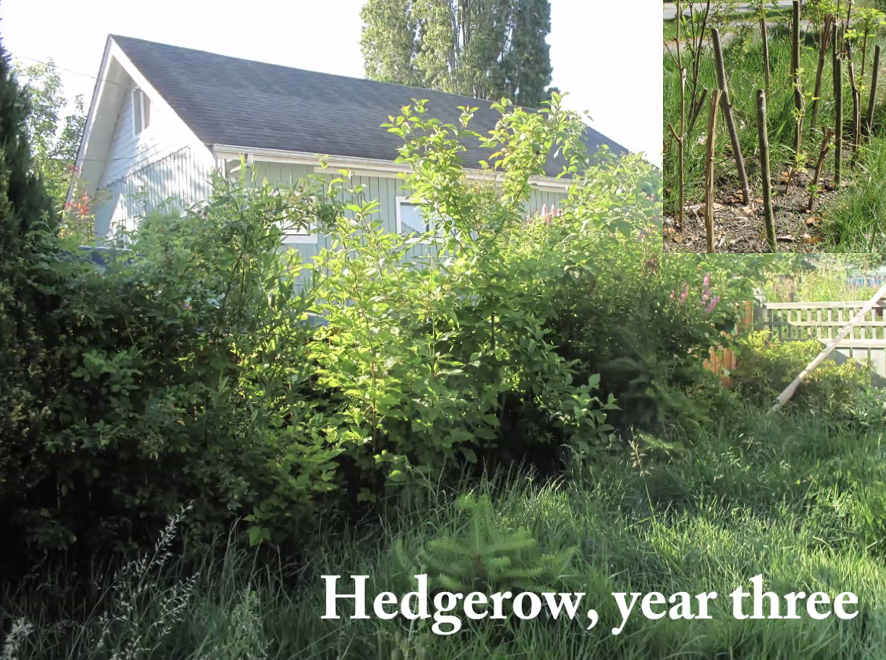
The first photo shows Year 3 after planting a hedge row of various native species, including Nootka rose, Snowberry, Pacific Ninebark and Salmonberry.
The hedge, year three. The inset is how the hedge looked in the first year. Based on screenshots taken during talk by Maleea Acker, April 22, 2023. Used with permission.

As well as the hedgerow, Maleea began to convert the lawn. She started with a few small sections of native bulbs -- Fawn lilies, and Camas, and planted a Garry Oak tree.

An image of the front yard showing the results of planting, with camas in bloom. Screenshot during talk by Maleea Acker, April 22, 2023. Used with permission.

Maleea rescues plants from development sites; she ran out of room in her yard, and is now restoring her boulevard.  

Maleea concluded her inspiring talk with the statement that 50% of our yard should be allocated for nature. Her 50% is her front yard; her back yard is devoted to food cultivation.

There were three other speakers after Maleea. 

Herb Hammond, forest ecologist and retired Registered Professional Forester, talked about the central place of water in urban development and introduced the concept "nature-directed stewardship". He covered many of the ideas that I described in my blog posts "In Praise of Rain Gardens" (https://linesfromthecoast.blogspot.com/2023/02/in-praise-of-rain-gardens.html),  "Rain, Rain, Rain" (https://linesfromthecoast.blogspot.com/2021/01/rain-rain-rain.html), "Rain, Rivers and Watersheds" (https://linesfromthecoast.blogspot.com/2020/11/rain-rivers-and-watersheds.html)

Danijela Puric-Mladenovic is a forester in the Faculty of Architecture, Landscape and Design at the University of Toronto. She spoke of some of the problems with our models of development on the larger scale -- the perception that nature is a disposable commodity, that we destroy soil and ecosystems, then try to add a bit of nature after the fact. 

Kazusa Nakajo is a multi-displinary accredited green builder, architect, eco-designer. She spoke of the importance of healthy soil in restoring nature in urban areas.

I don't have space in this post to give adequate time to the ideas of these professionals. Instead, I will finish with a couple of local examples of native plant gardening in or near James Bay. 

The first example is at the Royal BC Museum, which has created a large and intimate garden, all with native plants from different areas of BC.

This image captures the thickness of the native vegetation here.

Shrubs and trees, rocks and ground cover

Some of the ground cover in the native plant garden

There is always bird song here; the presence of the pond is an attractor.

The final image shows the signage that RBCM has installed about the garden:
Signage at RBCM Native Plant Garden
The second example is in an open area associated with South Park Elementary. It serves as both a playground for the children, and as a living science area.
Educating young people was mentioned during the webinar. This is the play area for children from South Park Elementary. In the foreground is a young Garry Oak, with a mature Garry Oak on the background. 

This area of the playground has been planted with native plants by children from the school. 

Plants are just beginning their growth for the spring; this is a variety of rose.
.
I'm not positive on this plant, but it was identified by one of my apps as from the Valerian family, with the common name of Seablush.

In this post I've only scratched the surface of how we can pay better attention to protecting and restoring nature in urban areas. Much more needs to be said... and even more to be done. It is, indeed, a matter of survival!